
Plug-In Solar: Coming Soon to a Porch, Balcony or Backyard Near You!
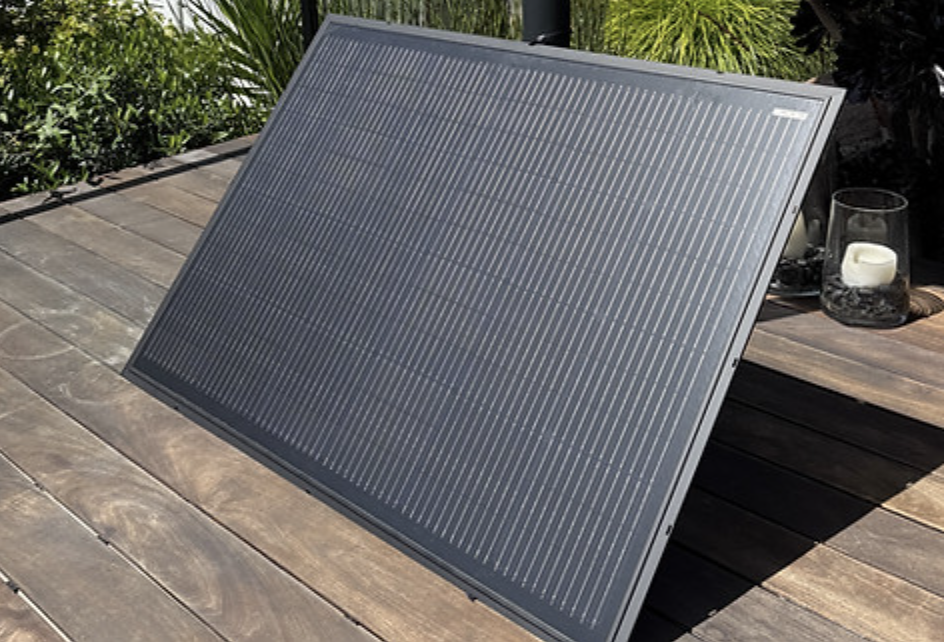
Image via brightsaver.org
A new generation of solar technology is rapidly on the rise across America, and it's on its way to Vermont. Plug-in solar (aka balcony or portable solar) promises to make clean energy simpler, more affordable, and more accessible than ever.
Plug-in solar has gained momentum around the world, driven by successful adoption of the small-scale solar systems across Europe – especially Germany, which alone has more than one million registered plug-in solar systems, with estimates suggesting that roughly five million units are currently in operation. They’re relatively cheap too. In Europe, you can easily purchase ready-to-install kits for around $340.
Now, plug-in solar is coming to the U.S. As of the time of writing, ten states have passed plug-in solar legislation. In two of those states, New York and New Jersey, the bills are pending governors’ signatures.
Act 149 went into effect in Vermont in July 2026, laying down the pathway for this emerging technology to be deployed across Vermont – soon. The law creates a clear framework for plug-in solar, but requires the deployment of certified systems that are not yet available in Vermont. Those systems are expected to become available on the market in the near future, but exactly how soon remains to be seen.
A chief reason plug-in solar has become so popular abroad is because it offers a new way to participate in the clean energy transition without the barriers that have traditionally come with rooftop solar. Plug-in solar is cheaper to buy, easier to install, and can still effectively lower a monthly energy bill. With the plug-and-play systems we see in Europe, renters, apartment residents, condo owners, and households without suitable roofs for traditional solar arrays can just buy a kit, set it up in a sunny spot, plug it into a standard outlet, and start saving.
However, we’re not quite there yet in Vermont. Most states where plug-in solar is legal have only just passed legislation, and American homes are often wired differently than their European counterparts. Furthermore, Vermont’s approach has been intentionally safety-first. Act 149 relies on one specific safety standard (UL3700) to certify plug-in systems designed specifically for U.S. electrical systems. But this safety framework is still its draft form. Until UL3700 safety standards are universally adopted by manufacturers – and that will take some time – installing plug-in solar systems will almost certainly require electrical work and a specific dedicated circuit, making it less plug-and-play and a little more costly and cumbersome for the moment.
While it is true that there currently are no plug-and-play systems on the market, there’s still plenty we can do. Already, several Vermont communities have begun some important organizing work to set the foundations for plug-in solar and help many more Vermonters save money while pursuing their energy independence.
Read on to learn more about plug-in solar, how this emerging technology works, and what creative Vermont communities are doing to help prepare for its arrival.
What is Plug-In Solar?
Unlike traditional rooftop or utility-scale solar, plug-in solar systems are small, modular solar installations designed to offset a portion of a household’s electricity use.
These systems typically include one or more solar panels connected to a micro-inverter that converts the electricity generated by the panels into usable household electricity (i.e. direct current to alternating current). They can be installed on a balcony, porch, backyard, shed, or anywhere else that gets good sun. The energy generated flows directly into your home network when plugged into a standard outlet. With certified equipment and proper installation, the electricity then follows the path of least resistance to be consumed in real-time by active home appliances.
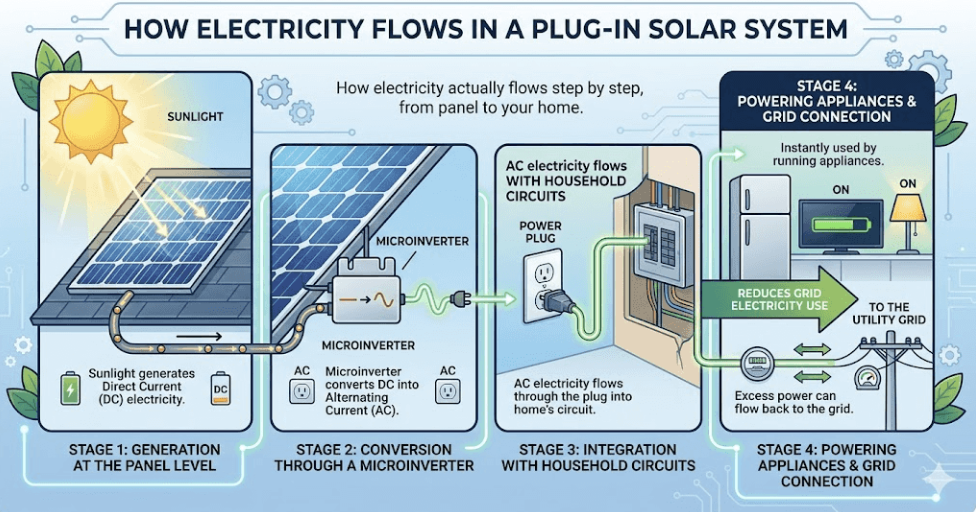
Image via ecoflow.com
Importantly, a plug-in solar system alone is not capable of powering an entire home. Under Vermont’s law, qualifying systems can have up to 1,200 W of combined inverter capacity per electric meter – or roughly 10% of the generation capacity of a typical residential rooftop solar system.
Therefore, the real appeal is in plug-in solar’s simplicity and accessibility. Traditional rooftop solar often requires significant upfront investment (a complication exacerbated by the loss of federal solar subsidies and curbs to VT’s net metering program), a suitable roof, ownership of the property, permitting, and a lengthy installation process. Plug-and-play solar, on the other hand, requires none of that.
In Europe, plug-in solar has taken off largely because it bypasses electricians and permitting barriers, can be plugged right into a standard wall outlet, and helps lower monthly electrical bills by a significant amount. Millions of households now rely on small balcony solar systems, often purchased as affordable kits and installed by homeowners themselves.
What Does Act 149 Do?
Act 149 allows for the safe deployment of plug-in solar systems of up to 1,200 watts of combined inverter capacity per electric meter once certified products become available.
Qualifying plug-in solar devices will not require:
Utility approval
Interconnection applications
Utility fees
A Certificate of Public Good
Unlike traditional solar projects, qualifying plug-in solar systems are not treated as full interconnection projects requiring utility review and approval. Act 149 does not require customers to notify their utility before installing qualifying systems. During the legislative process, utilities considered whether notification would provide meaningful value and determined that small, compliant plug-in solar systems would function similarly to other household devices that reduce electricity demand. As a result, Vermont’s approach focuses on ensuring system safety through certification requirements (which we’ll get into right below) rather than adding additional administrative steps.
What’s Holding Up Plug-In Solar in Vermont?
Plug-in solar, when properly certified and installed, is safe and has been successfully deployed at scale. While plug-in solar systems are already widely used in other countries, systems deployed in the U.S. need to meet the country’s specific electrical systems and safety requirements.
As with any technology that introduces new electrical equipment into a home, careful attention must be paid to circuit capacity, system design, and electrical protection. When you plug in your phone, a lamp, or another appliance, electricity flows in one direction – from the grid, through your home’s electrical system, and into the device. Plug-in solar changes that by allowing electricity generated by a small solar system to flow back into a household circuit through a standard outlet. Because of this different type of electrical connection, Vermont’s Act 149 requires plug-in solar systems deployed in the state to be uniquely certified and designed.
Luckily, a certification standard specific to plug-in solar has recently been developed for North America. UL Solutions, a leading organization in safety testing and certification for electrical and other technologies, developed UL3700, the Outline of Investigation for Interactive Plug-In PV (PIPV) Equipment and Systems. UL3700 offers utilities, local authorities, and consumers clear guidelines for consumer-installable plug-and-play solar systems. It addresses the specific safety considerations – including overcurrent protection, touch safety, and ground-fault circuit interrupter (GFCI) compatibility – needed to bring plug-in solar to the U.S. market.
UL3700 was drafted in December 2025, and UL still lists it as an “outline of investigation.” Additionally, it requires a proprietary connector setup that most existing hardware doesn't have. So, to date, no plug-in solar kit containing all three components – a panel, inverter, and plug – has been certified under the full UL3700 standard by a nationally recognized testing laboratory. Manufacturers are expected to bring compliant systems to market as soon after UL3700 is completed, but there’s no definitive timeline. We’ll be sure to let you know when that changes. Stay tuned.
Community Leadership on Plug-In Solar
Even if fully UL3700-compliant systems aren’t yet available, that doesn’t mean communities have to wait to start talking about plug-in solar. The groundwork for successful adoption can begin well before certified kits arrive on the market. Energy committees can begin educating residents, identifying interested households, and laying the groundwork for successful local deployment.
Brattleboro is just one community that has already started putting this approach into action. Led by the town’s Sustainability Coordinator and energy committee member, Stephen Dotson, Brattleboro is going all in on plug-in solar. Through a grant supported by the Municipal Energy Resilience Program (MERP) and the Coalition for Green Capital, Brattleboro surveyed residents to gauge interest in plug-in solar and collected addresses from interested households. Then, Stephen and other partners used GIS and LiDAR mapping to determine which of those homes have the best solar potential in order to identify where plug-in solar fits best and who could benefit the most
And they’re not stopping there. Stephen is also incorporating public education into his efforts. Through workshops, demonstration systems, and resource sharing, the town aims to help residents understand how plug-in solar works, who it could benefit, and what households will need before installing a system.
Looking ahead, Stephen sees opportunities that could benefit communities not only in Brattleboro but all across Vermont: building regional lists of interested households, organizing bulk purchases to reduce shipping costs, and pairing those efforts with incentives to help lower upfront costs.
Lastly, while there is plenty of excitement surrounding this novel technology, Stephen emphasizes that most Vermonters should wait for UL3700-certified products to become widely available before buying a system. As the market matures, we can expect prices to come down while product quality and consumer confidence should improve.
For more information about Brattleboro’s plug-in solar work, contact Stephen Dotson at sdotson@brattleboro.org.
Is your community organizing around plug-in solar – tell us about it! Reach out to fyoung@vnrc.org or info@vecan.net to tell us about what you’re up to, if you’d like to learn more, or with any questions!
To learn more about plug-In solar, check out these resources:
Webinar from Clean Energy NH: Plug-In to Power Up
UL Solutions’ Safety Considerations for Plug-in Photovoltaic (PIPV) Systems
Bright Saver’s Plug-In Solar: The Complete 2026 Guide for U.S. Homes and Renters
Plug-in Solar Fact Sheet from South Burlington (updated August 12, 2026)
Vermont State Policy: Act 149 – An act relating to plug-in photovoltaic devices
UL3700 Explained: The Safety Standard That Makes Plug-In Solar Legal
VPIRG’s Ben Walsh and Vermont Sen. Anne Watson discuss Plug-In Solar and UL3700
Bright Saver’s Why Balcony Solar Rules Are Different in Every State (And What That Means for You)
