
Celebrating 50 Years of Community Energy Leadership in Vermont
For more than half a century, as the world has struggled to tackle intensifying energy challenges in a changing climate, Vermonters have risen to the occasion by doing what we do best – finding practical solutions through local leadership, community collaboration, and civic action.
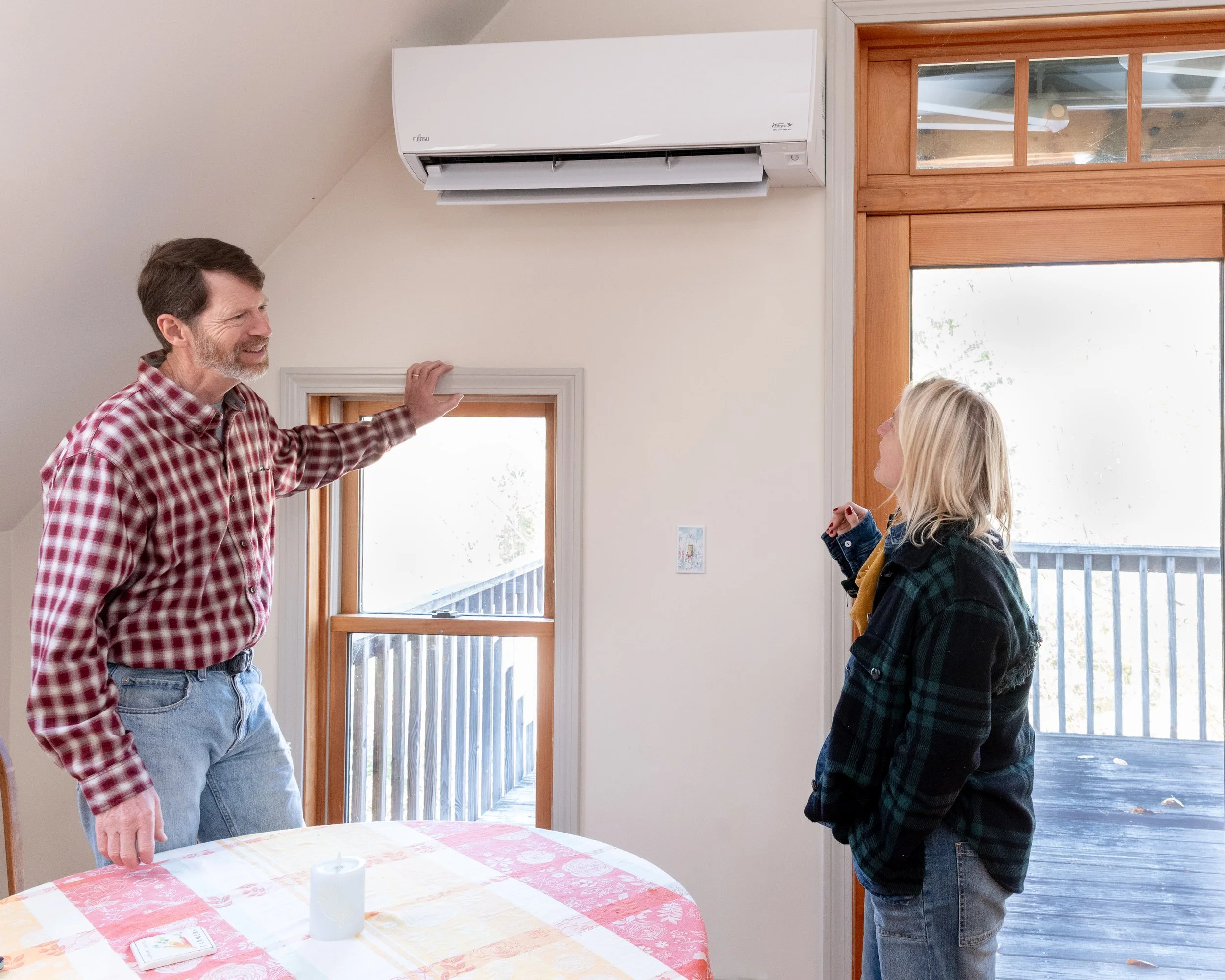
VECAN member and Waterbury LEAP founder and chair Duncan McDougall stands beside his heat pump — one of the many clean energy technologies championed by local energy committees.
From Energy Coordinators to Community Committees
In 1975, when the global energy crisis, oil embargoes and significant energy shortages sent shockwaves through the world’s economy, Vermont enabled – by law – the creation and appointment of “energy coordinators”. Their role? To help communities (and the people in them) use less energy. Energy coordinators worked directly with their municipalities to identify and implement energy-saving measures. They led conservation efforts by conducting energy audits, insulating drafty homes, lowering thermostats, educating communities about reducing energy use, promoting early solar technologies, and distributing low-cost efficiency tools – all strategies that helped reduce energy demand during a period of significant international energy shortages.
The work of energy coordinators played an important role then and that work continues today in new and needed ways. By the mid-2000s, as climate change – and its costs and impacts – became a more pressing challenge, communities built on that 1970s law by establishing community energy committees. Rather than relying on a single energy coordinator, Vermont communities embraced a coordinated, community-led committee approach to advance energy efficiency, deploy renewable energy, reduce reliance on fossil fuels, and help communities adapt to the on-the-ground impacts of a warming world.
Building the Statewide Network of Local Energy and Climate Action Leaders
To support and strengthen those new committees, the Vermont Energy and Climate Action Network, known as VECAN, was formed in 2005 with the goal of leveraging limited resources and fostering efficient, impactful coordination to support community-led clean energy and climate action priorities and projects.
The VECAN network is akin to a hub and wheel approach. Statewide, VECAN partners work to support Vermont’s dispersed network of more than 120 community energy committees by sharing information, resources and strategies, fostering community-by-community collaboration, and creating and deploying model approaches at the local level (and amplifying those models across Vermont) to get needed renewable energy, efficiency, and resilience solutions implemented swiftly and equitably.
The network is coordinated by the Vermont Natural Resources Council and supported by a backbone of organizations that work to understand, support, and help further the goals of community energy committees. The work of these grassroots groups is also supported by and a complement to the work of other key partners, including Regional Planning Commissions, Vermont’s Community Action Agencies, Efficiency Vermont, the state's electric distribution utilities and more.
Built on Community, Practiced in Delivering Solutions
VECAN’s local-led, grassroots-driven model has proven successful, including in rural Vermont – where a lot of communities lack the people power and the funding that makes it easier to make priorities and projects happen. Grounded in community-centered engagement and priority setting, the work of town energy committees has translated into reducing energy consumption and costs through weatherization and efficiency projects, bringing far more clean, distributed, renewable energy projects online, helping people understand the benefits of – and affording – driving electric, and far more.
It’s almost a 100% all-volunteer model. About half of the towns in Vermont have town energy committees, most appointed by their city councils or selectboards – their municipalities – to prioritize, plan for and advance renewable energy, efficiency, and transitioning to cleaner heating and transportation solutions.
These groups have played an important role because they are rooted in community first. They are focused on bringing benefits and results to their communities and are often seen as unbiased, trusted partners with a core focus on reducing energy costs and burdens – particularly for low-and moderate-income Vermonters who spend a far greater share of their incomes on energy costs compared to higher income Vermonters.
Since energy coordinators were first established 50 years ago, the evolution of this work to community energy and climate action committees has meant that they have played – and are continuing to play – a leadership role in identifying, advancing and implementing cost-saving, pollution-reducing and resilience solutions. Vermont town energy and climate action committee leaders have helped schools, municipalities, businesses and households go solar; weatherize homes, schools and businesses; transition municipal fossil-fueled fleets and personal vehicles to cleaner, more efficient and cheaper electric options; and employ a myriad of other technical assistance strategies to help Vermonters cut energy costs and climate pollution.
Their organized efforts help often when they’re needed most. For example, the Inflation Reduction Act (IRA) was the policy framework that prioritized, at scale, the deployment of cost-effective efficiency technologies and distributed renewable energy resources. – When it was enacted, these groups helped bring more resources and capacity to their communities.
An analysis by the media outlet Heatmap found that Vermonters utilized IRA efficiency incentives at the third fastest clip in the U.S. More than 10,000 Vermont households took advantage of IRA energy improvement tax credits over the course of 2023, bringing nearly $24,000,000 in federal funding into the state. Another analysis showed that Vermonters utilized IRA incentives at twice the pace the federal government anticipated, and with the support of those IRA incentives, Vermonters adopted heat pumps and other efficiency measures twice as quickly as the nation as a whole.
While it certainly wasn’t energy committees alone that made this progress possible, the successful implementation of IRA incentives was helped by the social infrastructure that this dispersed network of local leaders represents, like community building tools that foster conversations and engagement. These connections and support structures were critical in advancing clean energy solutions for all.
A Network Built for Today’s Challenges
The value of VECAN and the community-based network it supports extends beyond any single policy or funding opportunity because ongoing local leadership is essential.
That’s especially true today. In a world beset by political polarization, mis- and disinformation, and, increasingly, learned climate helplessness and apathy, local-led community action is a uniting force. As we grapple with two significant and interconnected global crises – the climate crisis and a volatile global energy market that has sent prices soaring – we must accelerate our efforts to transform our energy systems and guarantee that no Vermont community is left behind.
Russia’s invasion of Ukraine and, more recently, the United States’ war with Iran, shocked energy markets and drove up the cost of oil and gas across the world, almost overnight. The outfall, in part, has been skyrocketing energy costs that have strained household budgets and forced too many families to make decisions between paying their energy bills or putting food on the table.
The pain and the pinch of this moment has hit Vermont households and people’s pocketbooks hard. Since the U.S. invasion of Iran, prices at the pump have risen dramatically, by more than $75 a month in costs for the average Vermont driver. Concurrently, fuel oil prices have spiked. They were $1.11 per gallon higher in May 2026 than at the end of February 2026. This means the cost of a 200-gallon fuel delivery was over $200 higher, from about $800 pre-war to over $1,000 in April and May.
These challenges highlight why Vermont’s community-based energy network still has a defining role to play. Local leaders played an important role in 1975 and their work remains more important than ever. When energy costs rise and climate impacts intensify, town energy and climate action committees provide trusted, local leadership by helping Vermonters weatherize homes, access efficiency programs, adopt cleaner heating and transportation options, pursue renewable energy projects, and better understand the choices available to reduce energy costs and build resilience.
Vermont's people-powered network of committed Vermonters continues this essential work in communities across the state. This network includes town energy committee and climate action committee leaders, along with the organizations that support them. Their leadership is not only a piece of Vermont's energy and climate history. It is essential to meeting the challenges of today and tomorrow.
To learn more about this important people-powered network and framework for action, visit VECAN.net or reach out to info@vecan.net and someone on the VECAN team will connect with you!
